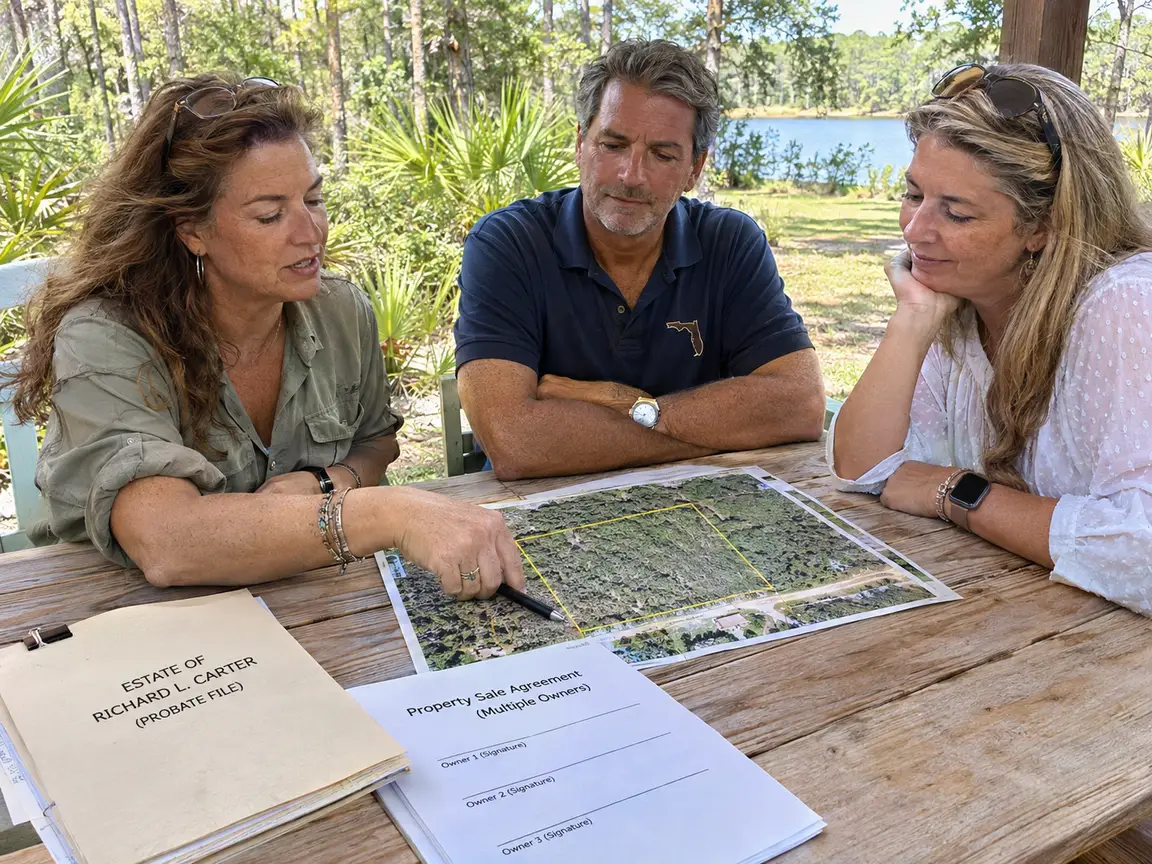
Few things complicate a land sale like having several owners. Maybe your parents left a lot to three siblings. Maybe a relative passed away, and the property now sits in the names of cousins you rarely speak to. One person wants to sell, another wants to hold on, and a third has stopped answering calls. Meanwhile, the property taxes keep coming.
If that sounds familiar, you are in good company, and you have more choices than you might think. This guide walks through how co-owned land works in Florida, the realistic ways to move forward, and how to keep a family decision from turning into a family fight.
This is general information, not legal or tax advice. For anything involving title or a court filing, talk with a Florida real estate attorney.
How Co-Owned Land Usually Happens
Co-ownership most often starts with inheritance. When someone dies owning land, it passes through probate to their heirs under a will or Florida’s intestacy rules. If there are several heirs, each can end up with a share of the same parcel. Land can also be co-owned by spouses, business partners, or friends who bought together years ago.
The key point is that each co-owner usually owns an undivided interest. Nobody owns the “north half” or “the lot by the road.” Everyone owns a share of the whole, and that is why decisions get tricky.
Why It Is Hard to Sell
A buyer and a title company need every owner with an interest in the property to sign the deed. If even one person refuses, cannot be found, or has not finished probate, the sale generally cannot close. That is true whether the holdout owns 5% or 50%.
Common roadblocks include:
- Owners who disagree about whether to sell or about price
- A co-owner who lives out of state or out of the country
- An heir who has passed away, adding their own heirs to the mix
- Unpaid property taxes, which build up while everyone waits
- An estate that has not completed probate, so nobody has clear authority to sign
None of these is unusual. Most are solvable with patience and the right sequence of steps.
Step One: Confirm Who Actually Owns What
Before anything else, get the facts straight. Order a copy of the deed and look up the parcel on your county property appraiser’s website. If the owner of record has passed away, find out whether probate has been opened or finished. Our guide to your options for selling land explains how ownership questions affect each route.
Write down every owner, their share, and their contact information. Missing owners are the most common reason a sale stalls, so start looking for them early.
Step Two: Have an Honest Conversation
Many family disagreements are really about money, fairness, or grief. A short, calm conversation about what each person wants can move things faster than any legal tool. Useful questions include:
- Does anyone want to keep the land or use it?
- Can everyone afford their share of taxes and upkeep?
- Would everyone accept a sale if the price is fair?
If you can reach agreement, you have the fastest and cheapest path. If not, keep reading.
Option 1: One Owner Buys the Others Out
If one co-owner wants to keep the land, they can buy out the rest. The owners agree on a value, ideally supported by an appraisal or a few independent offers, and the buyer pays each person their share. This works well when one heir has a real use for the land and the means to pay.
Option 2: All Owners Sell Together
When everyone agrees to sell, the process is straightforward. All owners sign the purchase agreement and the deed, and the proceeds are split according to ownership shares. Selling to a cash buyer can be especially helpful here, because there is no listing, no showings, and no repairs to argue over. You can see how it works in our simple selling process.
Option 3: One Owner Sells Their Share
In many cases a co-owner can sell only their own undivided interest. The catch is that very few buyers want a fractional share of vacant land. Offers tend to be low because the buyer cannot use or control the property alone. This option is usually a last resort if the others will not cooperate.
Option 4: Ask a Court to Divide or Sell It (Partition)
If owners cannot agree, Florida law allows a co-owner to ask a court for a partition, which is governed by Chapter 64 of the Florida Statutes. A court can divide the land physically when that is practical, or order it sold and the proceeds divided. Partition can resolve a deadlock, but it takes time, costs legal fees, and often results in a lower sale price than a voluntary sale. Most families find it worth trying every other option first.
Don’t Forget the Carrying Costs
While the family decides, the land keeps costing money. Property taxes are due every year, and unpaid taxes can eventually lead to a tax certificate sale. Vacant land that is neglected can also draw code enforcement fines or liens. Splitting these costs fairly, even temporarily, helps keep the peace and protects the value of the property. If you are already behind, our article on selling land with back taxes or liens may help.
Things to Watch Out For
- Signing anything without reading it. Make sure every owner understands the agreement and that the buyer’s terms are in writing.
- Pressure tactics. A legitimate buyer will give everyone time to review an offer.
- Skipping title work. A title company will need to confirm who can sign. Fixing issues early prevents surprises at closing.
- Handshake deals between relatives. Even among family, put the plan in writing.
How a Cash Buyer Can Help
We work with families in this situation regularly. We buy land as-is, so nobody has to clear or repair anything, and we cover the closing costs and charge no commissions or fees. We can make one offer that all owners can review, and we can work with your closing attorney or title company to handle probate and multiple signatures. Many of the common questions are answered in our frequently asked questions.
Ready to Move Forward?
If you share ownership of Florida land and want a clear, no-pressure way forward, we would be glad to help. Tell us about the property, and we will send you a fair cash offer you can share with the other owners. Request a no-obligation cash offer or call us at (239) 399-5800 to talk it through.