If you own a piece of Florida land with standing timber on it — a planted pine plantation your family put in decades ago, a mixed hardwood-and-pine tract you inherited, or acreage you bought as an investment and never actively managed — you’ve probably run into a frustrating problem: almost nobody selling land online talks specifically about timberland. Most guides are written for a quarter-acre residential lot, not sixty acres of merchantable pine.
Timberland is its own asset class. It has value in the trees themselves, value in the bare land underneath them, and a set of buyers who think about both very differently than the average land buyer. Here’s what actually matters if you’re trying to figure out what your Florida timberland is worth and how to sell it.
Why Florida Timberland Is Different From Other Land
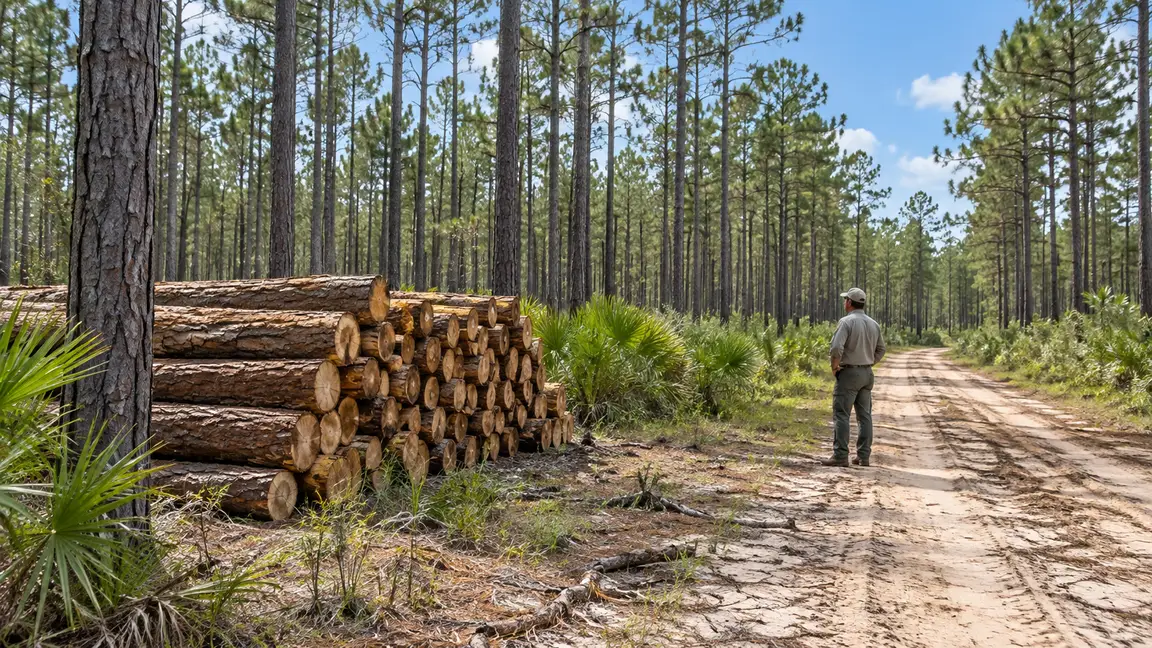
Roughly 80% of Florida’s forested acreage sits in the Panhandle and North Florida, where the soils and climate favor planted pine — mostly loblolly and slash pine grown on rotation for pulpwood and sawtimber. If your land is in Jackson, Holmes, Walton, Santa Rosa, Suwannee, Columbia, or similar counties, there’s a good chance it’s either an active plantation, a tract that was cut and replanted at some point, or natural timber that’s never been actively managed.
That distinction matters because it changes who’s interested in your property. A residential buyer or a builder generally doesn’t want standing timber — they see it as an obstacle to clear before they can do anything else. A timber buyer or an investor, on the other hand, sees the trees as an asset, and the land underneath as a second, separate value they’re also paying for.
What Actually Drives the Value of Your Timber
Species and stand age. Pine is the dominant commercial species in Florida, and its value depends heavily on where it is in its growth cycle. Young pine plantations (under 10–12 years) mostly have value as future timber, not current harvestable volume. Mid-rotation stands (roughly 12–20 years) start producing pulpwood-grade material. Mature stands (25–35 years and older) are where the real money is, because that’s when trees reach sawtimber size — the largest-diameter logs that go to sawmills instead of pulp mills, and pay meaningfully more per ton.
Volume, not just acreage. Two 40-acre tracts can be worth very different amounts depending on how densely and how well the timber has grown. This is why serious buyers don’t price timberland off acreage alone — they price it off estimated tons of pulpwood and sawtimber on the property.
Distance to a mill. Timber is heavy and expensive to haul. Land within a reasonable trucking distance of an active pulp mill or sawmill is worth more than an identical stand that’s an hour further from the nearest buyer, simply because of what it costs to get the wood there.
Market conditions at the time of harvest. Timber prices move with housing starts, pulp and paper demand, and how much competing timber is coming to market at the same time. This is genuinely outside your control, and it’s one of the reasons some owners get frustrated trying to time a harvest around price swings instead of just selling the property outright.
Because of all this, per-acre timberland values across the Southeast vary enormously — broad industry estimates for pine-dominated tracts commonly land somewhere in the low thousands of dollars per acre, with real numbers depending heavily on stand age, volume, and location. Treat any number you see online as a starting point for a conversation, not an appraisal of your specific property.
How a Timber Cruise Works
If you want a real number, the standard tool is a timber cruise: a licensed forester walks a sample of your property, measures tree diameter and estimates height and volume on those sample plots, and extrapolates an estimate for the whole tract. A cruise typically breaks the volume down by product class — pulpwood, chip-n-saw, and sawtimber — because each sells at a different price per ton.
A full cruise costs money and takes time, which makes sense if you’re planning an active harvest. It’s often overkill if your actual goal is simply to sell the property and move on — in that case, a buyer who’s comfortable estimating timber value from aerial imagery, county records, and a site visit can save you that upfront cost entirely.
Timber Deed vs. Selling the Land Outright
There are two very different transactions that sometimes get confused:
A timber deed (or stumpage sale) sells only the standing trees, usually with a set window of time for the buyer to harvest them. You keep the land itself. This can make sense if you want to cash out a mature stand but have no interest in selling the underlying property.
Selling the land outright — timber and all — transfers everything in one transaction. The buyer takes on the timber’s future value (and risk) along with the land itself.
If your real goal is to be done owning the property — not to squeeze out one more harvest cycle — selling outright is almost always simpler. It avoids managing a separate timber contract, coordinating logging access, and then still having to sell the cutover land afterward.
The Greenbelt Classification Wrinkle
Timberland is one of the uses that can qualify for Florida’s agricultural classification (often called Greenbelt), which taxes the property based on its agricultural use value instead of full market value. That can mean a meaningfully lower tax bill while you own it — but it also means a sale can trigger back taxes or a reassessment if the classification isn’t handled correctly at closing. If your timberland currently carries a Greenbelt classification, it’s worth understanding how that plays into a sale before you sign anything; our guide to Florida’s Greenbelt agricultural classification covers this in more detail.
Why Most Florida Timberland Owners Don’t Sell the “Textbook” Way
In theory, the standard path is: get a timber cruise, get an appraisal, list with a timberland-specialized broker, wait for the right buyer, negotiate, close. In practice, a lot of owners we talk to inherited the land, live somewhere else entirely, and don’t want to manage a multi-step sale process for a property they’ve never actively farmed for timber. Others have a stand that’s overdue for thinning, back taxes piling up, or boundary and access issues that make a traditional buyer nervous.
None of that means your land isn’t worth selling — it just means the textbook process isn’t always realistic for your situation.
A Faster Path: Selling Your Timberland for Cash
This is where working with a direct land buyer like FL Land Buyer can simplify things considerably. We look at the timber, the land, the access, and any tax or title issues together, and we make a straightforward cash offer for the whole package — no cruise required on your end, no listing, no waiting on a buyer who needs financing. You’re not paying commissions, and you’re not responsible for coordinating a harvest before you can close.
If you’re not sure whether your timberland is better sold as a timber deed, sold outright, or held for another few growing seasons, that’s a conversation worth having before you commit to any one path. Take a look at how our process works, or just get a no-obligation cash offer and see what your property is worth today — with no pressure to accept it.