When “No Road Access” Shows Up on the Title Report
Somewhere in Florida there’s a five-acre parcel that hasn’t seen a bulldozer since the 1970s. It was platted, sold sight unseen out of a mail-order ad decades ago, passed down through a couple of generations, and today the owner has no real idea how to get to it — because there’s no legal way to get to it. No recorded easement, no maintained road, just a survey line running through someone else’s property or a stretch of wetland.
If that’s your land, you’re not imagining the problem, and you’re not alone. Florida has more landlocked and “paper street” parcels than almost any other state — a legacy of the land-boom subdivisions of the 1950s through 1970s that platted tens of thousands of rural lots with roads that were drawn on paper but never actually built. If you inherited one of these parcels, or bought one sight unseen years ago, here’s what it means, what your legal options are, and what selling it for cash usually looks like.
If you’re newer to selling vacant land in Florida in general, our overview of how to sell your raw land is a good starting point before diving into the access-specific issues below.
What “Landlocked” Actually Means
A landlocked parcel has no legal, recorded access to a public road. That’s different from a lot that’s simply hard to reach — a landlocked parcel has no deeded right-of-way, no easement, and no road frontage of its own. To get to it, you’d have to cross someone else’s land, and unless you have their written permission or a court-recognized easement, you don’t have the legal right to do that, even if you’ve walked or driven across it for years without incident.
This shows up in a few common forms across Florida:
- Paper streets. The subdivision plat shows a road grid, but the county or the original developer never built the roads. The lot sits inside a platted block with no physical access.
- Landlocked interior lots. A larger parcel was split among heirs or buyers over the years, and the interior piece ended up with no road frontage of its own.
- Wetland or conservation buffers. The only practical route in crosses land that’s now protected, permitted for something else, or owned by someone unwilling to grant access.
Why This Happens So Often in Florida
Florida’s rural land market was shaped by decades of speculative platting — developers bought large tracts, sliced them into thousands of small lots, and sold them nationwide with minimal infrastructure. Some of those roads eventually got paved. Many didn’t, especially in the more remote platted communities across Central and North Florida. Decades later, county road departments have no obligation to build a road just because a plat map shows one, and a title company usually flags the gap the moment a sale gets underway — which is often the first time an owner finds out there’s a problem at all.
Do You Have Legal Options to Get Access?
Yes, in most cases, and Florida law is actually fairly favorable to landlocked owners. Under Florida Statute 704.01, there are two routes.
Common-Law Implied Easement
If your land was once part of a larger tract that had access, and it was split off without preserving a route in or out, the law presumes an easement was intended across the land that shared common ownership with yours.
Statutory Way of Necessity
If your parcel is genuinely “shut off or hemmed in” with no practicable way in or out, and the land is used or intended for a dwelling, agriculture, timber, or livestock, you can petition the court for a statutory easement over the nearest practical route — even if it crosses land you’ve never owned.
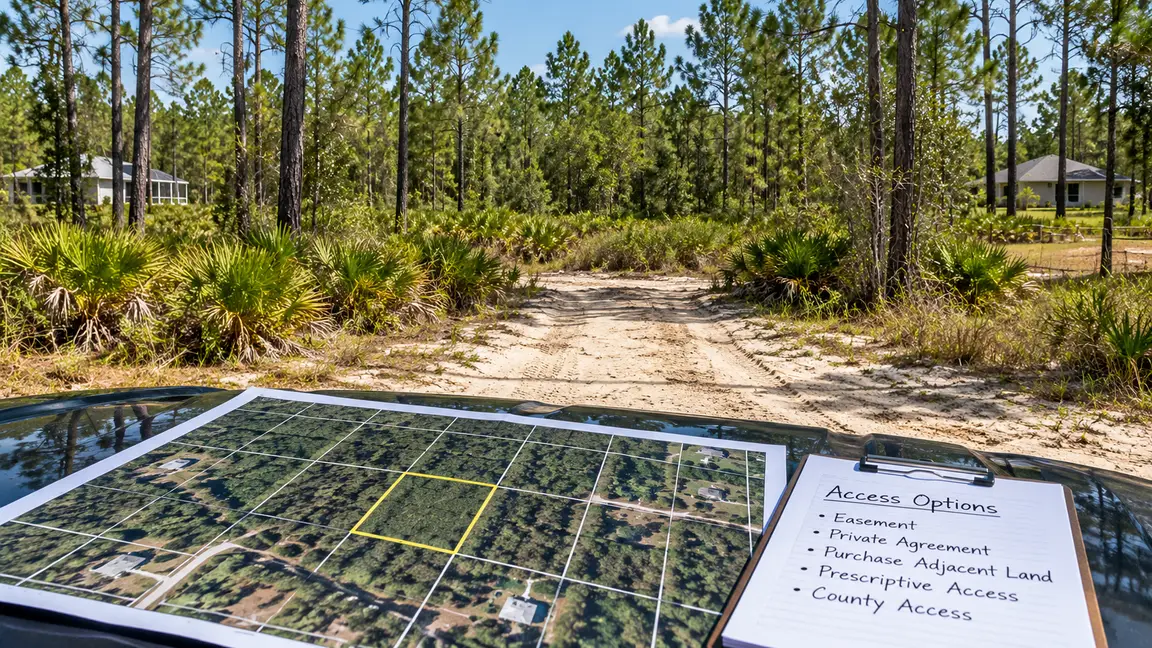
Both routes usually mean hiring a real estate attorney, likely a survey, and possibly a lawsuit if the neighboring owner won’t cooperate voluntarily. It’s a real path, but it isn’t quick — these cases often take months, and a court can require you to compensate the landowner whose property the easement crosses. The simpler option on paper is tracking down whoever owns the land between you and the road and negotiating a private, recorded easement directly. That avoids court, but only works if that owner is willing, and rural ownership records aren’t always current or easy to trace.
For more on how we handle title and access questions like this during a sale, see our FAQ.
Why Landlocked Land Is So Hard to Sell the Normal Way
Even once you understand your legal options, they don’t solve the practical problem: almost nobody wants to buy land they can’t currently drive to.
- Lenders won’t finance it. Banks generally won’t write a mortgage on a parcel without confirmed legal access, which rules out most retail buyers who need financing.
- Appraisals come in low. Appraisers discount landlocked parcels heavily, sometimes by half or more compared to a similar lot with road frontage, because the buyer pool and the timeline to resolve access are both so limited.
- Agents often pass. A listing that requires a buyer to hire an attorney and possibly go to court before they can use the property is a tough sell for agents, who are compensated on closed transactions, not legal groundwork.
- Title companies slow everything down. Even a motivated buyer has to get through title work that will flag the access problem and may require an attorney’s opinion before insuring the title.
None of that means the land is worthless. It means the realistic buyer pool is narrower, and the sale usually needs someone willing to deal with the access question directly, rather than someone expecting a plug-and-play closing.
What Selling It for Cash Actually Looks Like
This is the kind of situation direct cash buyers exist for. When we evaluate a landlocked parcel, we’re not expecting a cleared path and a driveway — we’re pricing in the access issue from the start, the same way we’d account for back taxes or an unresolved estate. That means:
- No financing contingency to fall through when a lender says no.
- No requirement that you resolve the easement question before you sell — we take on that risk, not you.
- A cash offer that reflects the real, current market for landlocked Florida land, not a number based on comparable lots with road access.
You won’t get the same price you’d get for an identical parcel with a paved road out front — that’s the honest trade-off of an access issue, no matter who ends up buying it. But you also won’t spend a year and several thousand dollars in legal fees trying to force access before you can sell at all.
What to Have Ready
If you’re not sure whether your land is technically landlocked, a few things will tell you quickly: your deed and the subdivision plat map (available from the county property appraiser or clerk of court), any prior title work or title search done when you inherited or purchased the land, and whatever you know about how the land has actually been accessed in the past, even informally.
Bring what you have — you don’t need a resolved legal answer before you reach out. That’s exactly the kind of groundwork we sort through as part of making an offer.
If you’re ready to see what your landlocked parcel is worth as-is, get a no-obligation cash offer and we’ll walk you through it from there. And if you’re still deciding whether selling outright makes more sense than pursuing legal access yourself, our guide to the options for selling your land can help you weigh both paths before you commit to one.