Divorce is hard enough without a piece of vacant land sitting in the middle of it, tying up your name, your credit, and your ability to move forward. If you and your spouse own land together — a lot you bought as an investment, acreage you planned to build on someday, or a parcel that came with the marriage some other way — you’re probably wondering what happens to it now, and how to get it resolved without dragging the process out any longer than it needs to be.
Here’s what you need to know about selling land during a Florida divorce, and how to make it one of the simpler parts of an otherwise complicated process.
Is the Land Marital Property or Separate Property?
Florida is an equitable distribution state, not a community property state. That distinction matters. “Equitable” doesn’t mean an automatic 50/50 split — it means the court divides marital assets in a way it considers fair, based on each spouse’s contributions, the length of the marriage, and a handful of other factors.
Generally speaking:
- Marital property includes land purchased during the marriage, regardless of whose name is on the deed.
- Separate property includes land one spouse owned before the marriage, or received individually as a gift or inheritance — as long as it wasn’t commingled with marital funds or retitled into both names along the way.
That second point trips people up more than anything else. If one spouse owned a lot before the marriage but marital money was used to pay the property taxes, make improvements, or pay down a loan on it for years, a court may treat some of that appreciation as marital, even if the land itself stays separate. If there’s any ambiguity about which category your land falls into, that’s a conversation for a family law attorney, not something to guess at — the answer directly affects who has a legal say in the sale.
Your Options When You Both Own the Land
Once it’s established that the land is marital property (or that you’ve agreed to treat it that way for simplicity), you generally have three paths forward.
Sell It and Split the Proceeds
This is the cleanest option for most couples, and it’s the one that comes up most often. You sell the land, agree on how the proceeds get divided (not always a strict 50/50 — that’s negotiated as part of the settlement), and you’re both fully out of the asset. No ongoing co-ownership, no shared property tax bill showing up every November, no need to agree on anything about that parcel ever again.
One Spouse Buys Out the Other
If one of you wants to keep the land, the other can be bought out for their share of its value, either with cash or by trading equity in another marital asset. This works, but it requires an accurate valuation and enough liquidity on the buying spouse’s side to actually make it happen — which isn’t always realistic, especially if most of the marital assets are tied up in the primary residence.
Keep It as Co-Owned Property After the Divorce
Technically possible, rarely a good idea. Continuing to co-own land with an ex-spouse means you’re both still financially tied to a shared asset — property taxes, potential code enforcement issues, decisions about if and when to eventually sell — long after the marriage itself is over. Most attorneys and financial advisors will steer clients away from this option unless there’s a very specific reason (like waiting on a rezoning decision) to make it worth the ongoing entanglement.
What If the Divorce Isn’t Final Yet?
You don’t necessarily have to wait until the divorce is finalized to sell jointly owned land, but both spouses typically need to agree to the sale and sign off on the transaction while it’s still pending. If the divorce is contentious, a court can also issue orders about what happens to marital property in the meantime — including, in some cases, restrictions on selling assets without the other spouse’s consent or the court’s approval.
If you’re mid-divorce and considering a sale, loop your attorney in before you get too far down the road with a buyer. It’s a much smaller conversation to have upfront than trying to unwind a sale after the fact because one spouse didn’t actually have the authority to sign.
Why Selling Land During a Divorce Is Different From Selling a House
Selling the marital home during a divorce tends to be emotionally loaded — it’s where you lived, raised kids, built a life. Vacant land is usually a more straightforward asset to part with. There’s no staging, no moving out, no debate about who keeps the furniture. It’s often just a number on a settlement worksheet that needs to become cash so it can be divided and the whole thing can be closed out.
That said, vacant land can also be harder to sell quickly through a traditional listing than a house is. It’s a smaller buyer pool, financing is less common, and land can sit on the market for six months to a year in a lot of Florida counties. If you’re trying to finalize a divorce and don’t want a slow-moving land listing holding up the settlement, that timeline mismatch is worth thinking through early.
How a Cash Sale Can Simplify a Divorce
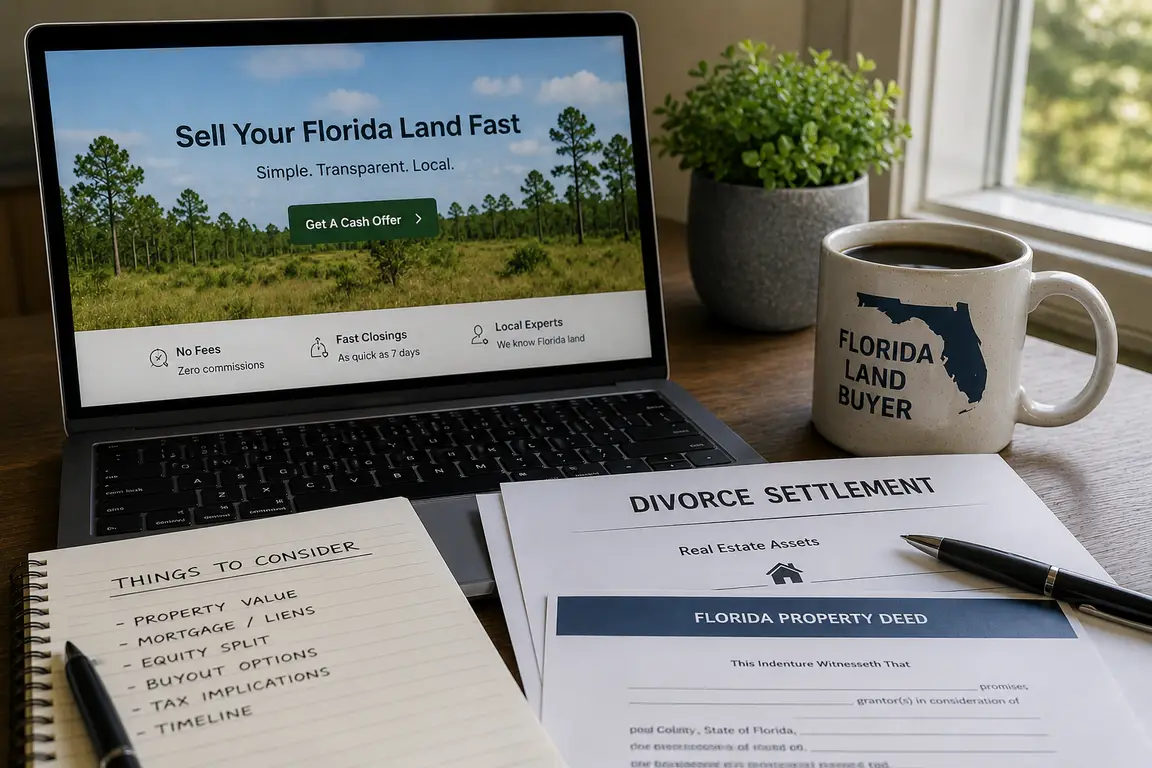
This is exactly the kind of situation a direct cash sale tends to solve well. A few reasons it fits:
- Speed. A cash sale can close in one to three weeks, compared to potentially a year on the open market — helpful when you’re trying to move a divorce settlement toward a close, not stretch it out.
- No ongoing shared costs. Every month the land doesn’t sell is another month you and your ex are technically still tied together through a joint tax bill and, potentially, a joint mortgage or loan.
- One clean number. A straightforward cash offer gives you a defined number to work into the settlement instead of an estimated, uncertain future sale price.
- No repairs, no showings, no back-and-forth. Neither of you has to coordinate maintaining a marketable listing together during a divorce, which is its own kind of relief.
If you’d like to see the full range of ways people in your situation typically handle a sale like this — cash, listing, or otherwise — our page on options to sell land walks through the tradeoffs of each.
Steps to Sell Land During a Divorce
- Confirm whether the land is marital or separate property with your attorney.
- Get an accurate, current valuation of the parcel so any settlement negotiation is based on real numbers, not guesses.
- Decide together (or through your attorneys) whether to sell, buy out, or hold — most cases point toward selling.
- Get both signatures lined up if the divorce isn’t final, since both owners typically need to consent to the sale.
- Choose your sale method — a cash buyer if speed and simplicity matter, a listing if you have time and want to test the open market.
- Close and divide the proceeds according to your settlement agreement.
A Word on Timing and Taxes
Selling before versus after the divorce is finalized can affect how the sale is taxed, and whether any capital gains exclusion applies differently to each spouse. Every situation is different depending on how long the land was held, its cost basis, and the terms of the settlement itself — this is genuinely worth a short conversation with a tax professional or your attorney before you sign anything, rather than assuming your situation matches a friend’s.
Get a Straightforward Cash Offer on Your Florida Land
If you’re navigating a divorce and need to sell land you co-own in Florida, we can make the property part of this simple: a fair, no-obligation cash offer, no repairs or showings to coordinate with an ex, and a closing timeline that can actually keep pace with your settlement. Get your free cash offer here and see what a straightforward, no-pressure sale looks like.