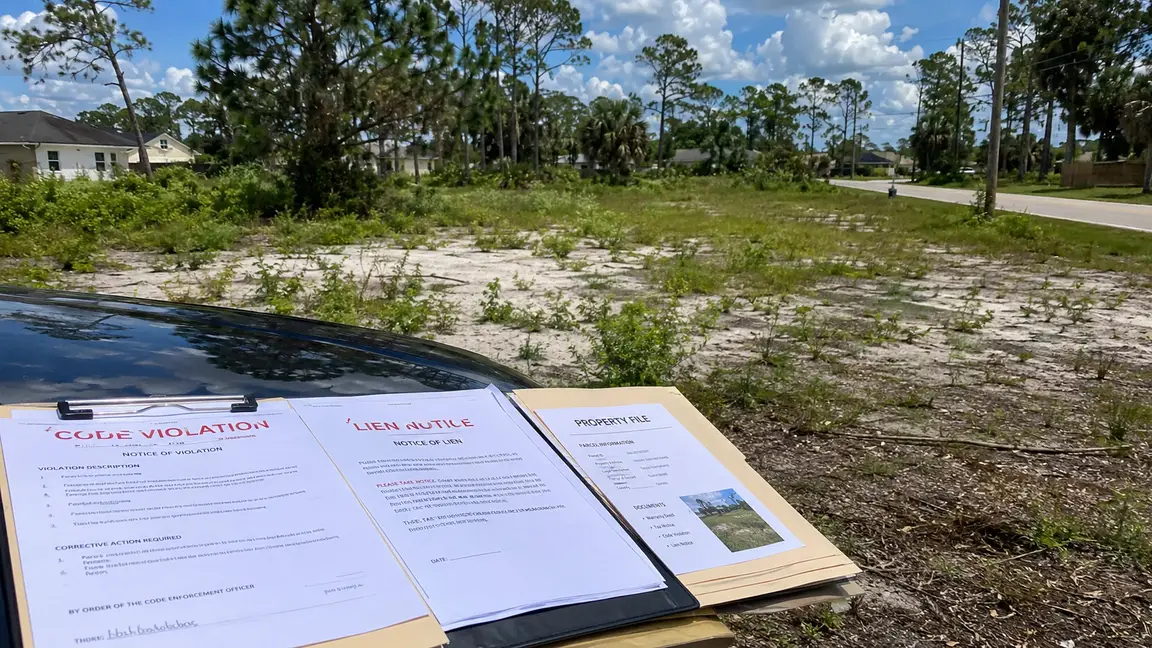
If you’ve gotten a letter from your county’s code enforcement office about tall grass, dumped debris, or an “unsafe condition” on a vacant lot you own, you’re not alone — and you’re not stuck. Overgrown and neglected vacant land is one of the single most common code enforcement complaints in Florida, especially on lots owned by someone who lives out of state, inherited the property, or simply hasn’t visited in years.
The problem is that these violations don’t go away on their own, and the fines attached to them can grow a lot faster than most landowners expect. Here’s how the process actually works in Florida, what it can cost you if you wait, and how selling the land — even with an open violation or lien — is usually simpler than people assume.
How Code Violations Turn Into Liens in Florida
Florida cities and counties operate under state law (Chapter 162 of the Florida Statutes) that lays out a fairly standard process for code enforcement:
- A code officer identifies a violation — most often overgrown vegetation, illegal dumping, an unpermitted structure, or a safety hazard.
- You’re notified and given a deadline to fix it, sometimes with a chance to correct it before any hearing happens.
- If it isn’t corrected, the case goes in front of a code enforcement board or special magistrate, who issues an order and can start daily fines for every day the violation continues.
- If the fines go unpaid, the county records the order, and it becomes a lien against the property — which stays attached to the land until it’s paid, even if you sell or transfer it.
That last step is the one that catches people off guard. A lien doesn’t disappear when you decide to sell; it has to be resolved as part of closing, the same way a mortgage or a tax lien would be.
How Fast the Fines Add Up
Daily fines for code violations in Florida typically run somewhere between $100 and $500 per day, depending on the county and the severity of the issue. A simple “mow the lot” violation that sits unresolved for a few months can snowball into a five-figure lien — not because the underlying problem was expensive to fix, but because nobody addressed it in time.
Standards vary quite a bit by location. Collier County, for example, doesn’t allow grass and weeds over 18 inches tall before it’s a violation. Punta Gorda’s threshold is lower, at 12 inches, and repeat violations within a two-year window can get a property enrolled in a mandatory lot-mowing program (billed back to the owner). Other municipalities have their own rules for debris, standing water, and unpermitted clearing. If you own land in more than one Florida county, it’s worth checking each one separately — what’s fine in one jurisdiction can be a violation in the next county over.
Why This Happens So Often on Vacant Land
Unlike a house, vacant land doesn’t have anyone living on it to notice a problem before it becomes official. Common triggers we see with landowners include:
- Inherited land where the new owner lives out of state and doesn’t know the property needs regular maintenance
- Lots that were bought years ago as an investment and simply forgotten about
- Overgrowth or dumping by neighbors or trespassers that the owner never even witnessed
- Old structures, sheds, or debris left behind by a previous owner
In almost every case, the owner isn’t negligent — they just didn’t know the county was watching, or didn’t have a practical way to maintain land they rarely see in person.
Your Options If You Have a Violation or Lien
1. Fix the violation and request a reduction. If you’re able to bring the property into compliance, most boards will consider reducing accrued fines, especially for a first-time violation and a landowner acting in good faith. This usually requires attending a hearing and showing proof the issue is resolved.
2. Pay off the lien before selling. Some owners choose to clear the debt before listing, which can simplify the transaction but requires having the cash on hand.
3. Sell as-is to a cash buyer. This is the option most of our sellers choose. A direct cash sale can typically account for an outstanding lien or violation as part of the offer and closing process, instead of requiring you to clear it yourself first. That means no mowing, no hearings, and no waiting on a magistrate’s schedule.
Traditional buyers and lenders are usually far less comfortable closing on a property with an open lien — it can hold up financing or scare off retail buyers entirely. That’s one of the main reasons landowners in this situation come to a direct buyer instead of listing the property.
What to Do If You’re in This Situation Right Now
If you’ve received a violation notice, the most important thing is not to ignore it — fines accrue whether or not you respond, and the county doesn’t need your permission to record a lien once the order is entered. A few practical steps:
- Read the notice carefully for the deadline and hearing date
- Contact the code enforcement office to ask what’s required to close out the case
- Get a copy of any recorded order or lien amount before you make a decision
- Decide whether it makes more sense to resolve it yourself or sell the property as-is
If the math doesn’t make sense to fix it yourself — or you simply don’t want to deal with a magistrate hearing over a piece of land you don’t visit — selling directly is usually the fastest way out from under it.
We Buy Florida Land With Open Violations and Liens
Scott and the team at FL Land Buyer regularly work with owners dealing with exactly this situation. We can look at the property, the violation, and the lien amount, and put together a fair cash offer that accounts for it — so you’re not the one stuck resolving it with the county. For more on how the process works from start to finish, take a look at our step-by-step selling process or browse our frequently asked questions if you want more detail before reaching out. You can also review all of your options for selling land in Florida if you’re still deciding what’s right for your situation.
If you’re ready to see what your land is worth as-is, request your free, no-obligation cash offer today. We’ll walk you through exactly how the lien or violation factors into the offer, with no pressure and no hidden fees.