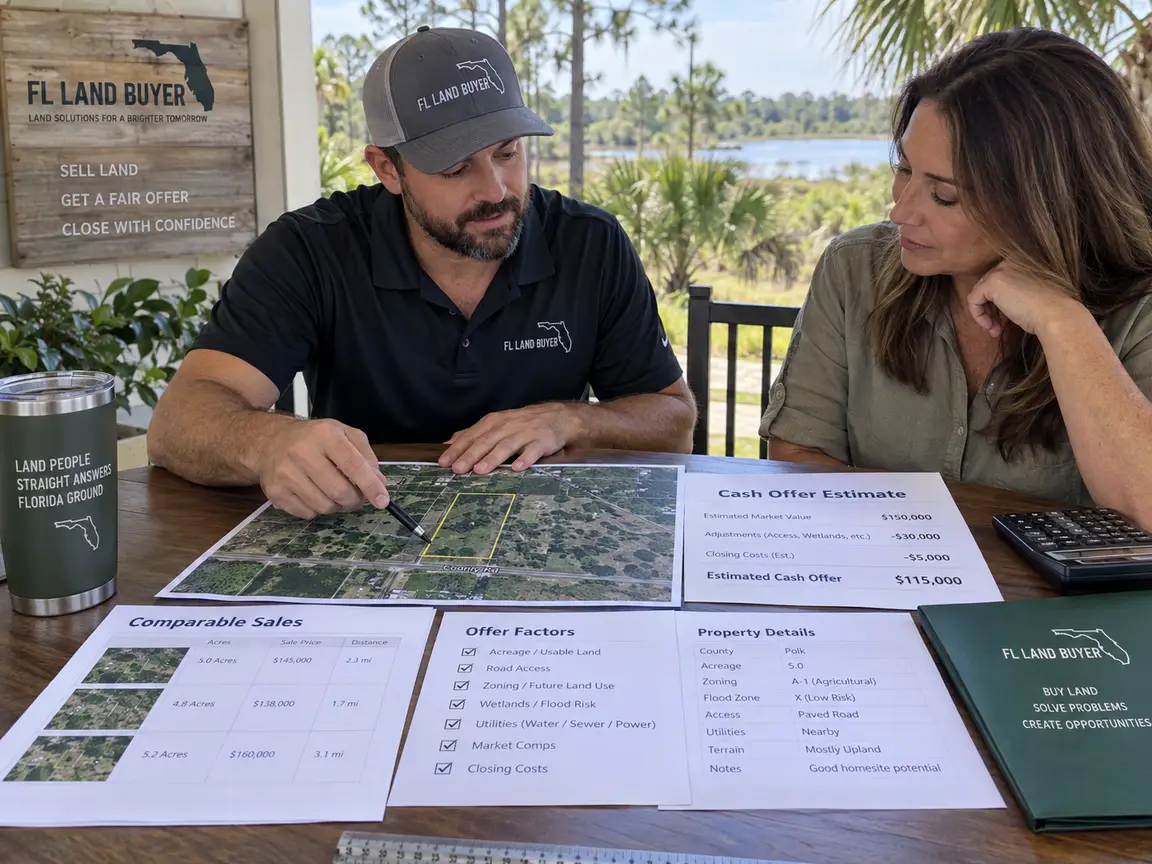
If you’ve requested a cash offer on your Florida land and the number that came back felt lower than you expected, you’re not alone — and you’re not necessarily being lowballed. Most landowners have never seen how a cash buyer actually arrives at a figure, so it can feel like it was pulled out of thin air even when it wasn’t. Understanding the math behind a cash offer won’t necessarily make the number bigger, but it will help you tell a fair offer from a genuinely low one, and it takes a lot of the mystery — and the anxiety — out of the process.
Land Isn’t Priced Like a House
When you sell a house, there’s usually a steady stream of recent, comparable sales nearby, and an agent or appraiser can lean on that data with real confidence. Vacant land doesn’t work that way. Two parcels a quarter-mile apart can be worth very different amounts depending on access, elevation, wetlands, utilities, and whether anyone has actually wanted to build there in the last few years. Sales are less frequent and less consistent, which means land buyers have to do more legwork — and use more judgment — to land on a number. That’s part of why cash offers on land can vary more than cash offers on houses.
The Core Formula Most Cash Buyers Use
Every buyer does this a little differently, but almost all of them are running some version of the same calculation:
Estimated resale value − selling costs − holding costs − back taxes/liens/clean-up − buyer’s margin = your cash offer
Here’s what each piece means in practice:
- Estimated resale value. What the buyer thinks they can sell the parcel for once it’s theirs — based on recent comparable land sales, county records, and sometimes a call to a local broker who works that area regularly.
- Selling costs. Closing costs, marketing, and often a real estate commission the buyer expects to pay when they eventually resell the property.
- Holding costs. Property taxes, and sometimes insurance or mowing/code-compliance costs, for however long the buyer expects to hold the land before it resells. Land in a slower-moving market gets discounted more here, because it ties up the buyer’s money longer.
- Back taxes, liens, or clean-up. If the parcel has delinquent taxes, a code violation, illegal dumping, or an old mobile home that needs removal, that cost typically comes off the top rather than getting passed back to you at closing.
- Buyer’s margin. Every land buyer needs to make something on the deal, or they can’t stay in business long enough to buy anyone else’s land either. A fair margin reflects the real risk and effort involved; an unreasonable one is the difference between a solid offer and a lowball one.
Why Two Offers on the Same Parcel Can Differ by Thousands
If you’ve reached out to more than one buyer, you may have already noticed the numbers don’t match — sometimes by a wide margin. A few reasons that happens:
- Data quality. A buyer who knows your specific county well will price more accurately than one working off a national database with thin local data.
- Risk tolerance and business model. Some buyers plan to hold land for years; others are trying to resell (or “wholesale”) it within weeks. The faster someone needs to turn the deal around, the more conservative their number tends to be.
- How much diligence they’ve actually done. A quick, automated online quote is a starting point, not a final number. A more thorough buyer who has pulled the plat, checked for wetlands or easements, and looked at recent comparable closings will usually land closer to what the property can really support.
Neither the highest nor the lowest offer is automatically the “right” one — but understanding why they differ helps you ask better questions.
How to Tell If a Cash Offer Is Fair
A few questions worth asking any buyer before you sign anything:
- What comparable sales did you base this on? A buyer who can point to specific, recent, nearby sales is doing real work. One who can’t explain their number at all is a yellow flag.
- What’s being deducted, and why? If your offer is lower than you hoped, ask specifically whether it’s because of back taxes, a title issue, access problems, or just the buyer’s margin. A straightforward answer is a good sign.
- Is this offer net to you, or are there hidden costs later? Most reputable land buyers cover standard closing costs, which is different from a traditional home sale where the seller usually pays a chunk of those costs themselves.
It’s also reasonable to get more than one offer and compare them — just keep in mind that a large national lead-generation site and a buyer who actually knows your county may land on very different numbers for very different reasons.
What “No-Obligation” Actually Means
A genuinely no-obligation cash offer means exactly that: you can request one, review it, ask questions, and say no with zero cost or commitment on your end. There’s no fee to get an offer, no contract you’re locked into just by asking, and no pressure to accept the first number if it doesn’t work for you. If you do move forward, there’s typically a short due-diligence period where the buyer confirms title and any issues with the property before closing — that’s normal, and it protects both sides.
When a Cash Offer Makes Sense — and When Listing Might Net You More
A cash offer isn’t automatically the better financial outcome in every situation, and it’s worth being honest about that. If your land is clean (no back taxes, no title issues), easily buildable, and in a location with real buyer demand, listing it with an agent and waiting for the right buyer can sometimes net you a higher price before commissions. The tradeoff is time, marketing effort, and the commission itself.
A cash offer tends to make the most sense when speed and certainty matter more than squeezing out the last few percent — for example, if the land has back taxes or liens, if it’s landlocked or otherwise hard to finance a purchase against, if you inherited it and live out of state, or if you simply don’t want to deal with showings, surveys, and an open-ended timeline. You can see a fuller breakdown of the tradeoffs on our options for selling your land page, and walk through exactly what happens after you accept an offer on our how it works page.
Common Questions Sellers Ask About Cash Offers
Does a lower offer mean my land isn’t worth much? Not necessarily — it may reflect back taxes, access issues, or a slower local market rather than the land’s underlying value. Ask the buyer to walk you through their number.
Can I negotiate a cash offer? Often, yes, especially if you can point to a comparable sale the buyer may have missed, or if you’re willing to handle something yourself (like clearing a small code violation) in exchange for a better number.
How fast does the money actually show up after I accept? That depends on the buyer and whether there are any title issues to clear, but many straightforward parcels close within a couple of weeks.
Have a question that’s not covered here? Our full FAQ covers more of the details sellers ask about most.
Get Your Own Cash Offer
If you’d rather just see the number than run the math yourself, that’s what we’re here for. Tell us a little about your Florida land and we’ll walk you through exactly how we arrived at your offer — no pressure, no obligation, and no cost to find out. Get your free cash offer today.